

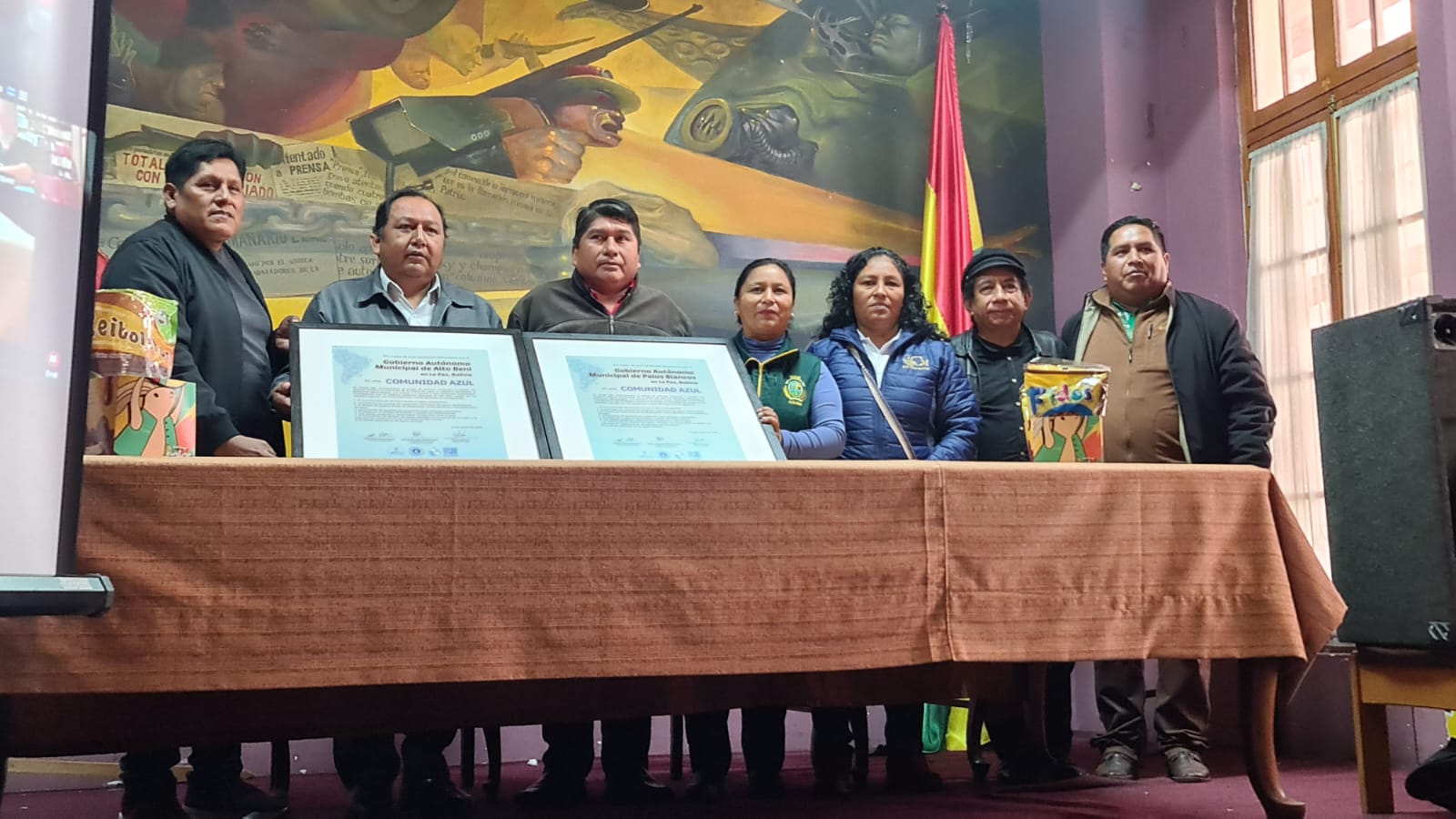
At the headquarters of the La Paz Federation of Press Workers (FTPLP), and in the presence of mayors and officials from the municipalities of Alto Beni and Palos Blancos, both municipalities received international recognition designating them as “Blue Communities” for declaring themselves mining-free and choosing to pursue agroecology and the production of cacao, citrus fruits, and other Amazonian products.
Now, the hope is that other municipalities will also declare themselves mining-free and that a national law will recognize those that do so. Therefore, setting aside any agreements with sectors that exploit the environment, the new departmental authorities of La Paz—who will soon be elected in the second round of subnational elections—are being called upon to respect these sovereign decisions.
Nancy Chambi, president of the Alto Beni Municipal Council, noted that more municipalities could join together to be declared mining-free. Photo: V. Ledezma/ANA
“The truth is that this recognition has been a struggle of more than five years for our own region—and even longer—it is something that we in Alto Beni have sought since the beginning of our growth, following in the footsteps of our grandparents who have always watched how we care for the environment, how we ensure that everything we have cultivated remains as it is,” said Nancy Chambi, president of the Alto Beni Municipal Council. Water justice, agroecological production, and opposition to mining.
Water justice, agroecological production, and opposition to mining and all forms of extractivism.
Recognition of the work to defend, protect, and care for the territory through the promotion of water justice, food sovereignty, agroecological production, and opposition to mining and other extractive activities confirms that the municipalities of Alto Beni and Palos Blancos meet the requirements to be designated a “blue community” because they uphold the following principles:
- Recognition of the human right to water and sanitation
- Promotion of community-managed water and sanitation systems
- Rejection of all forms of privatization, commercialization, and commodification of water
- Promotion of cooperation agreements among community systems
- Work to defend the territory and care for the environment
- Environmental and administrative management as transparent as water
- A commitment to return used water with the purity of its source or, at the very least, in a condition suitable for recycling by the sources
- Proper management of wastewater
“We have also joined forces with the municipalities of San Buenaventura and Rurrenabaque; they already have a zero-mining law, which gives us the strength to know that we are not alone—we are uniting, and we are growing stronger. “We recently had visits from Mapiri and Guanay, as well as from the municipality of Cobija, where they were able to see the agricultural system we’ve implemented. They’re very grateful, surprised, and eager to replicate this,” emphasized the president of the Alto Beni Municipal Council.
As of today, there are three Blue Communities in Latin America: two in Colombia and one in Chile. The Blue Communities project was created by a Canadian council, the Canadian Union of Public Employees, and the Blue Planet Project, with the goal of restoring aquatic habitats, exercising food sovereignty, and ensuring municipal autonomy.
“It brings us great joy to be recognized—in the case of Palos Blancos—as a pollution-free municipality, but we must continue working against pollution; this is not the end of the story. once we take office, we will follow up on this and work toward zero mining,” pledged Jesús Chucamani, mayor-elect of the municipality of Palos Blancos for the 2026–31 term.
Leave a Reply